
|
|
 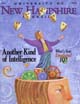 Cover illustration by Byron Gin  
|
 
Another Kind of Emotional Intelligence What's Your Emotional IQ? See also: By Anne Downey '95G Right now, his mind is on Gordon Bower, a well-known cognitive psychologist at Stanford University with whom Mayer did his post-doctoral work. Bower's last group of graduate students are finishing their Ph.D.s, and Mayer is reminiscing. "Once I was delivering a lecture at a colloquium on some research I was doing," he says. "A visiting faculty member interrupted me and said, 'I don't understand why this work is of any consequence.' I gave my standard answer concerning the significance of the work and prepared to go on. The visitor, however, interrupted again and said, 'It just seems uninteresting to me.' Now, I stopped, stumped. As I was trying to think of what to say, a booming voice came from the back of the room--Gordon, of course. He's sometimes compared to John Wayne. 'Well, I think it is interesting.'" Mayer does a convincing impression of John Wayne at a psychology colloquium: macho, but with credibility. "And then Bower said to me, 'Proceed.' And, of course, I did." There are other reasons why Gordon Bower is on Mayer's mind. When you are a well-known psychologist, people read what you publish, and your credibility is always on the line. Mayer has cause to remember the pressure that Bower was always under because now it is his as well. "No matter where I try to tuck an article away, no matter how small or obscure the journal that publishes it, someone will dig it up. It's funny and strange," he says. It wasn't always this way. When he and his research partner, Peter Salovey, who is a professor at Yale, first began working on emotional intelligence in the late 1980s, their sense was that no one was paying much attention. The two met while Mayer was teaching at SUNY Purchase and Salovey was a graduate student at Yale. Both had a long-standing interest in how emotions and intelligence interact. As Mayer explains it, "We just thought that having the head and the heart continuously opposed was a very superficial idea." But their idea--that using emotions effectively constitutes an intelligence, one that can be proven empirically--was so radical that they were not entirely convinced of it themselves. "When we started publishing on emotional intelligence, we were kind of trying out the idea," Mayer says. They published their first two articles on emotional intelligence in 1990, and followed up with two or three more in the next couple of years. Their concept was cited in other social science literature perhaps four or five times before 1995, "and probably two or three of those times, we were the ones who cited it," Mayer jokes. Still, their early empirical studies suggested that emotional intelligence existed. Then Daniel Goleman came along. A science journalist trained as a psychologist, Goleman was working on a book that he was calling Social and Emotional Competence. He had read Mayer and Salovey's work and was adopting parts of their model, and he called to ask if he could use their term, "emotional intelligence," as his title instead. "There was no legal reason that he couldn't," Mayer says. "And I remember mentioning to a colleague that Dan Goleman was writing a book and wanted to use emotional intelligence as the title. She said, 'That name is bigger than you and Peter, and you just have to let it happen.'" Goleman's book, Emotional Intelligence, published in 1995, was a huge success and is still an international bestseller. The media pounced on the concept: Time magazine ran a cover story on it, and several other popular magazines included articles about it. "Emotional intelligence" soon became a catchphrase bandied about water coolers everywhere. (Goleman followed up with Working with Emotional Intelligence in 1998, and several other popular books and tests have been published as well). Mayer doesn't mind the attention being paid to his concept, except for one major problem: there are significant differences between the popular understanding of emotional intelligence and the scientific definition, differences that speak to the integrity of the concept itself. In fact, many scientists have dismissed the concept of emotional intelligence because books like Goleman's have merely duplicated already-existing studies of personality, adding little new to the field. 
Easy to print version blog comments powered by Disqus Current issue | Past issues | Class notes Department archives | Send a letter/news | Address updates Advertise | About UNH Magazine | Alumni home | UNH home University of New Hampshire Alumni Association 9 Edgewood Road Durham NH 03824 (603) 862-2040 alumni@unh.edu |
 rofessor of psychology